
Signs your supply pipes are near the end.
One of these is a prompt to look. Several together is a pattern.
- Brown or rusty water, especially after the house has sat idle..
- Pressure that is low at every fixture and has gotten worse over the years..
- Repeated pinhole leaks, in the same line or different ones..
- Green or white crust on exposed copper joints..
- A house built before the late 1960s with the original galvanized steel plumbing..
- Visible rust or flaking on pipes in the basement..
Galvanized pipe and why it fails from the inside.
Galvanized steel supply pipe was common in houses built before about 1960. The zinc coating wears away, the steel rusts from the inside, and mineral buildup narrows the bore. Over decades, a one-inch pipe can pass the flow of a half-inch.
The result is low pressure and rust-colored water, then pinholes. Patching one leak does not slow the rest. Each repair also disturbs corroded sections nearby.
If your house has galvanized lines, we check by magnet and a scratch test at an exposed section. Tell us when you call.
Tired of patching leaks? Call and ask about a repipe plan and a clear price.
Call (855) 575-2890PEX, copper or CPVC.
The material shapes cost, speed and wall damage.
| Material. | Strengths. | Trade-offs. |
|---|---|---|
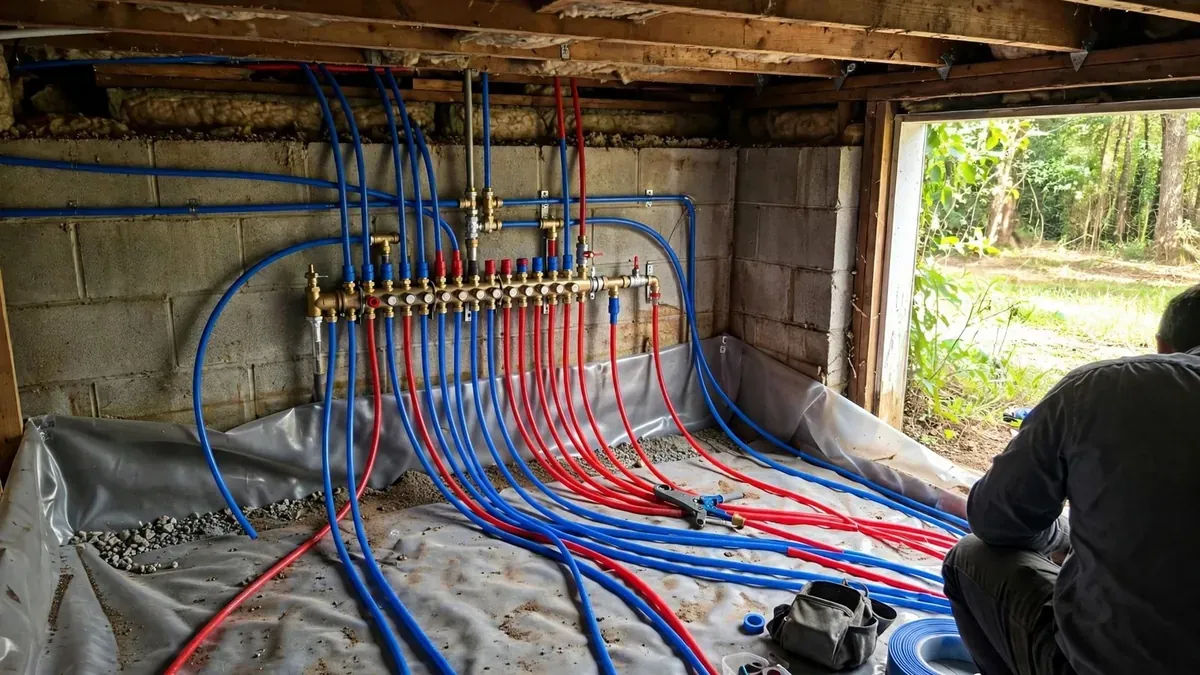
| PEX. | Flexible, fewer fittings, quick to install, resists freeze splits better than rigid pipe. | Not for direct sun, some prefer metal. |
| Copper. | Long track record, durable, fire resistant. | More expensive, more labour, can corrode with certain water. |
| CPVC. | Lower cost, rigid. | Becomes brittle with age and heat. |
Whole house or partial repipe.
A whole-house repipe replaces all supply lines from the main to every fixture. It is the right choice when multiple lines are failing or the material is galvanized throughout.
A partial repipe replaces one section, for example a kitchen branch or the line under a slab. It costs less and may be enough if the rest is sound. We look at the pipe and tell you which route makes sense.
Where a slab leak has hit a line under the floor, rerouting through the attic or walls avoids the slab. See our leak detection page for how we find those.
How a repipe is done.
Survey and plan.
We walk the house, locate fixtures, and decide the routes with the least wall damage.
Shut off and open access.
We make small access cuts, often behind fixtures or in closets, rather than large holes.
Install new lines.
New pipe runs from the main to each fixture. We connect to the existing fixtures and valves.
Test, patch and restore.
We pressure-test every line, then patch the cuts. Finish painting is for you or your contractor.
How long the water is off.
A whole-house repipe takes from one to several days, depending on the size of the house and access. We schedule so you have water at night, and plan the sequence so a toilet and a sink stay usable.
Partial repipes are often done in a day.
Repiping older Chillicothe homes.
Chillicothe has houses from every century since its founding in 1796. Houses from the 1800s have been re-plumbed at least once, and the oldest supply lines you find may be galvanized steel, copper or a patchwork of both. We open a small section and look before quoting.
Rural homes near Kingston with water from the Ross County Water Company, which reports moderately hard water of 7 to 8 grains per gallon, tend to show scale in older galvanized and copper alike.
What affects repiping pricing.
We quote the project after we see the house.
- Size and layout. Number of bathrooms, floors and fixtures.
- Material. PEX is usually less than copper.
- Access. Open basements and attics are faster than finished walls.
- Permits and inspections. Ohio plumbing inspections fall to the county health district under OAC 1301:3-2-04.
Some insurers ask about galvanized or old plumbing when writing a policy. A repipe can help with underwriting. Ask your agent, and keep the invoice.
Materials and rules for new pipe.
New supply pipe has to be an approved material under the Ohio Plumbing Code, built on the International Plumbing Code (IPC). Copper, PEX and CPVC for potable water carry NSF/ANSI 61 marking. Each has its own installation limits, such as support spacing and exposure to sunlight, set by the manufacturer.
What to do before a repipe starts.
Repiping opens walls and shuts water off for hours, so prepare the house.
- Clear the areas where walls will be opened and cover or move furniture.
- Plan for no water during the work and fill containers for drinking and flushing.
- Locate the main shutoff valve and confirm it fully closes.
- Keep children and pets out of the work zone.
- Ask how drywall patching is handled before work begins.
Repiping questions answered.
.
Rusty water, low pressure throughout, galvanized pipe and repeated leaks are signs. We inspect an exposed section and give you an honest opinion.
.
No. We use small access cuts, existing chases and attic or crawlspace routes where possible.
.
Yes, PEX approved for potable water is widely used in homes.
We use fittings and pipe rated for drinking water and tell you the brand.
.
Usually yes. We work in stages and set up temporary water as needed.
.
Yes. See burst pipe repair for service.