
What the sound or symptom tells us.
Disposals fail in recognizable ways.
| Symptom. | Likely cause. | Typical fix. |
|---|---|---|
| Hums but does not spin. | Jammed flywheel or seized motor. | Free the jam with a hex key and reset, or replace the unit. |
| Totally silent. | Tripped reset, bad switch or dead motor. | Press reset, check the outlet and switch, then test the motor. |
| Leaks from the bottom. | Cracked housing or failed seal. | Replace the disposal. |
| Leaks at the top flange. | Loose mounting or worn gasket. | Reseat or replace the sink flange seal. |
| Sink backs up through it. | Clog in the drain line past the disposal. | Cable the line. See drain cleaning. |
| Smells or runs slow. | Food buildup on the grind chamber. | Clean, descale and check the drain. |
Jammed disposal: what is safe to try.
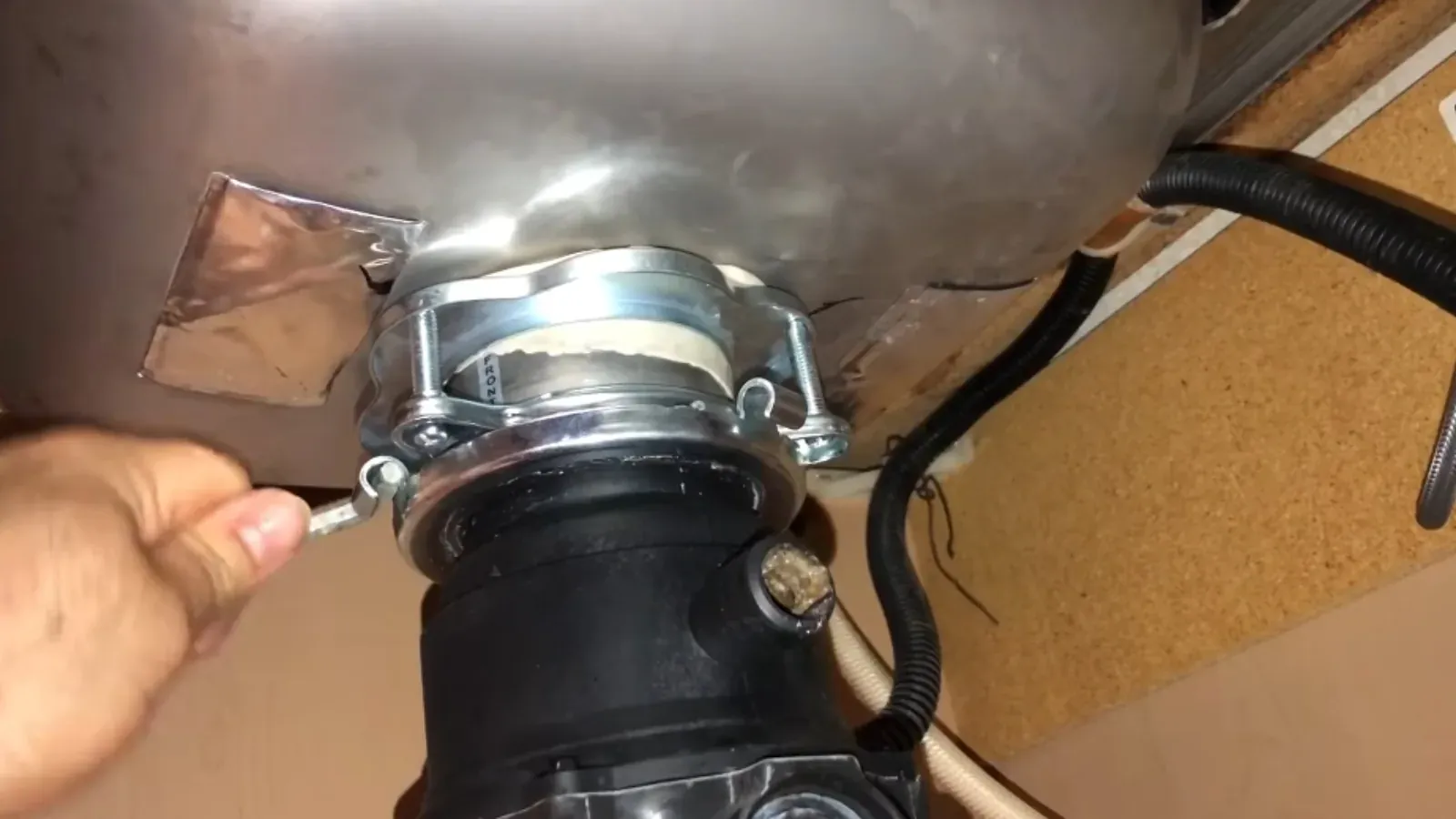
With the power off, look under the unit for a small hex socket in the center of the bottom. A hex key turned back and forth frees the flywheel. From above, use a wooden spoon handle to push loose any visible object.
Once it turns freely, press the red reset button on the bottom and restore power. If it hums again or trips right away, the motor or the start capacitor is failing.
Do not use a screwdriver in the grind chamber or pour chemicals into a jammed unit. We see more injuries and damaged blades that way than from the jam itself.
Disposal leaking or sink full of water? Switch it off and call. Call and we talk it through.
Call (855) 575-2890Leaks under the sink.
A leak under the sink can come from the disposal, the dishwasher hose, the drain trap or the faucet supply lines. A towel and a flashlight help: dry each part, run water and watch where the first drop forms.
Leaks from the body of the disposal mean the housing has cracked, and the unit must be replaced. Leaks at the flange or the drain elbow are fixable with new seals.
If the cabinet floor is wet, remove everything stored there and dry it. Particleboard swells and rots quickly.
Kitchen sink clogs past the disposal.
When the sink fills with gray water, the blockage may sit in the kitchen branch past the disposal. Grease, coffee grounds and fibrous scraps such as celery and potato peel pack into the line.
We cable the line from the trap arm or a cleanout and, if grease is heavy, follow with a jet. More on the process is on our drain cleaning page.
A disposal that works fine but drains slowly is almost always a line problem, not a motor problem.
Repair or replacement visit.
Diagnose.
We test power, free any jam, and check the motor and mounting for damage.
Choose repair or replace.
A reset, a seal or a jam is a repair. A cracked housing or a burned-out motor is a replacement.
Install.
A new disposal mounts under the sink flange, connects to the drain and dishwasher port and plugs into the existing outlet or a new cord.
Test.
We run water, grind a test load, check for leaks and show you how to reset and clear it.
Choosing a replacement disposal.
Horsepower matters less than motor build quality and sound insulation. A half or three-quarter horsepower unit suits most households, and higher horsepower suits those who use the disposal heavily.
Continuous feed models start when you flip a switch. Batch feed models run only with a stopper in place, which some prefer for safety around children.
Septic households should ask us before installing one, because heavy food waste adds to tank solids.
Disposals and older Chillicothe kitchens.
Older houses near downtown Chillicothe may have kitchen drain lines of cast iron or galvanized steel that are rough inside, and a disposal pushes food scraps into them. Pipes like this clog more often and catch grease at every joint.
If your kitchen line has clogged repeatedly, a camera run before installing a new disposal can show whether the drain can handle one.
What affects disposal repair pricing.
We give a clear price before work begins.
- Repair or replacement. Small fixes cost less than a new unit.
- Unit size and features. Higher horsepower and sound insulation add cost.
- Plumbing changes. Misaligned drains, a new dishwasher connection or electrical work add scope.
- Hour of the call.Ask about any call-out charge before you agree to a visit.
A disposal leak that soaks a cabinet may be covered by homeowners insurance if sudden. Keep the failed unit and take photos.
Electrical and plumbing rules.
A disposal ties into the drain trap under the Ohio Plumbing Code, built on the International Plumbing Code (IPC), and into an electrical circuit that follows the National Electrical Code (NEC), NFPA 70. We shut off the circuit before touching the unit and never put a hand in the chamber. Use the manufacturer's hex key socket at the base to free a jam instead.
Garbage disposal questions answered.
.
Whether garbage disposal emergencies can be handled in the evening or on a weekend is confirmed when you call (855) 575-2890, and it is not promised in advance. Describe what is happening and ask what can be arranged. Meanwhile, switch the unit off at the wall and keep hands out of it.
.
Something is jamming the flywheel, or the motor is weak. Turn off the power and free it with a hex key. If it keeps happening, the motor may be failing.
.
Grease, coffee grounds in quantity, fibrous vegetable peels, pasta and rice that swell, and bones.
Cold water running during and after use helps carry solids through the line.
.
Often 8 to 12 years with normal use. Leaks from the housing mean replacement, no matter the age.
.
We advise against heavy use. If you want one, we explain how it adds to tank solids so you can decide.