
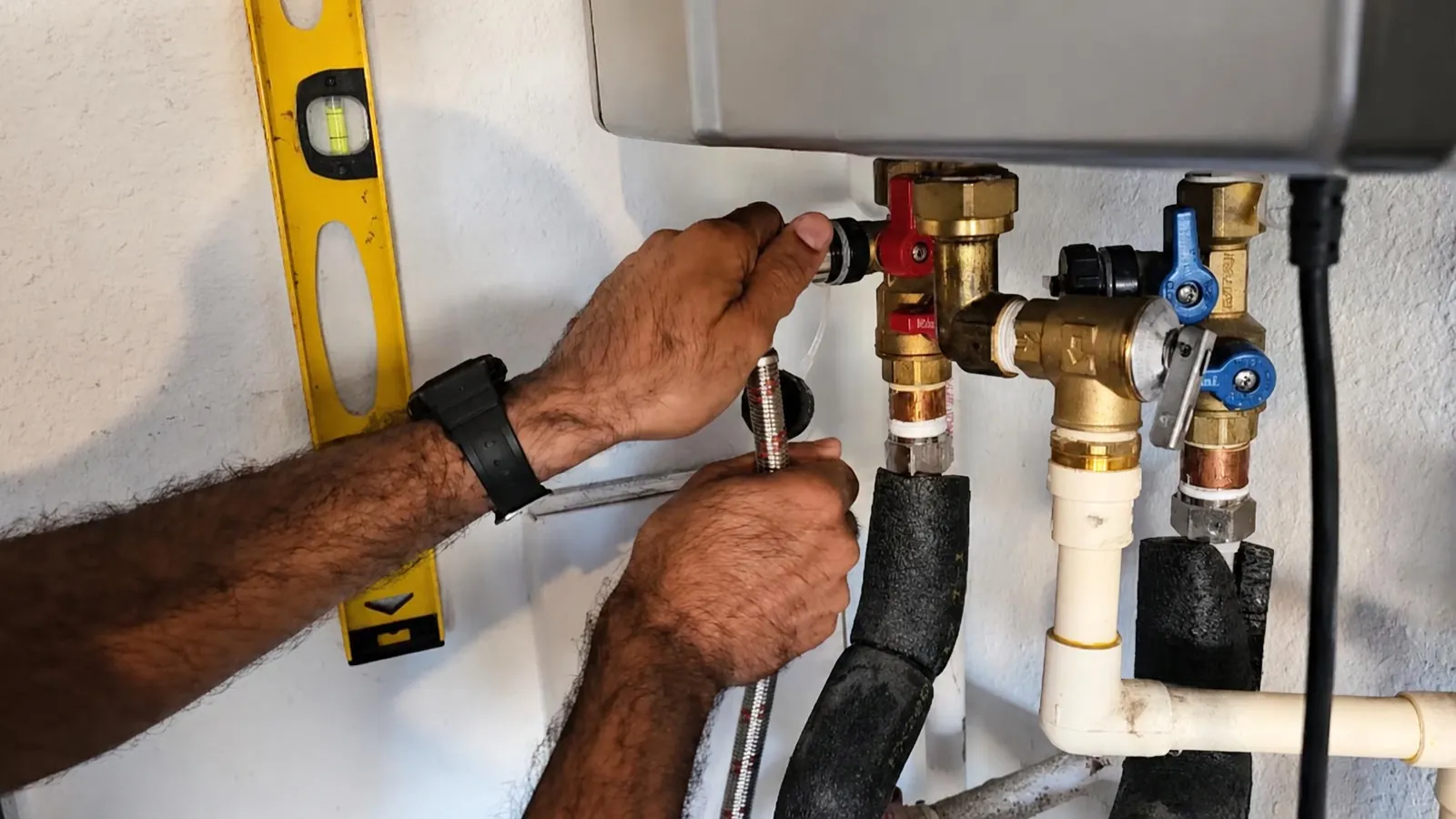
Following the water through the unit.
A tap opens.
Water begins to flow. A flow sensor inside the heater detects it and signals the control board.
The burner or elements fire.
A gas unit ignites its burner. An electric unit energizes heating elements.
The heat exchanger transfers heat.
Cold water travels through coils or fins surrounded by the hot gases or elements.
A mixing valve sets the temperature.
The unit mixes some cold water back in to hit the set point and keeps it steady.
The tap closes and the unit shuts off.
The flow sensor sees no flow and the burner stops. No water sits waiting.
The one number that matters: gallons per minute.
A tank stores hot water, so a shower and a dishwasher can both draw from it until it runs low. A tankless unit has no storage, so its limit is how many gallons per minute it can heat at a set temperature rise.
Temperature rise is the difference between the cold incoming water and the hot water you want. In winter, groundwater is colder, the rise is larger and the same unit delivers fewer gallons per minute. Sizing for January rather than July avoids a lukewarm shower.
Add up the fixtures that might run at once. A shower might use two to three gallons per minute. A dishwasher and a washer add more.
Weighing tankless against a tank? Call for a survey of your gas, vent and power.
Call (855) 575-2890What your house must provide.
Most surprises on a tankless install come from the supporting systems.
| Requirement. | Gas unit. | Electric unit. |
|---|---|---|
| Fuel. | A gas line large enough for the burner's input. | A heavy-gauge circuit, often multiple breakers. |
| Venting. | Sealed plastic or stainless vent through a wall or roof. | None needed. |
| Condensate. | A drain for acidic condensate on high-efficiency units. | Not needed. |
| Water. | Clean inlet, a filter screen, service valves for flushing. | The same. |
| Space. | Wall mounting with clearance for the vent. | Compact, often near the point of use. |
Why scale is the enemy.
Hard water leaves mineral scale inside the heat exchanger. A thin layer insulates the water from the heat, and a thicker layer narrows the passages. The unit then runs hotter, trips on safety limits or throws error codes.
Annual descaling, in which a pump circulates a mild acid through the exchanger, keeps scale in check. Our tankless water heater page describes the visit in detail.
A water softener protects the unit between flushes, and our water softener and filtration page explains when one is worth it.
What it feels like to live with one.
Hot water arrives after a short wait while the unit fires and the water in the pipes clears. If the fixture is far from the unit, the wait is longer. A recirculation line or a small buffer tank can shorten it.
The upside is continuous hot water. A long bath, a second shower and a load of laundry do not run it dry, provided the flow stays within the unit's rating.
Very low flows, such as a slow-running tap, may not trigger the unit. This is called the minimum flow, and it varies by model.
Cost, savings and what to expect.
A tankless unit costs more than a tank to buy and install, often noticeably more once venting and gas or electrical upgrades are included. It saves energy by not keeping water hot all day, but the savings take years to repay the extra cost in many homes.
It can make the most sense when the old tank is failing, when the family is large and a tank never keeps up, or when floor space matters. If you only need a replacement for a leaking tank, see water heater replacement.
Tankless in a Ross County winter.
Groundwater in southern Ohio is cold in January, and the unit must work harder. The Ross County Water Company's 2024 report lists total hardness of 120 to 140 milligrams per liter for the system that serves rural Ross County customers, which is enough to make scale a long-term concern for a heat exchanger. City of Chillicothe customers should check their utility's current report or test their tap.
Ohio licenses plumbing contractors under Chapter 4740 of the Revised Code, and plumbing inspection is the jurisdiction of the county health district under Ohio Administrative Code 1301:3-2-04. Ask whether a permit applies before a tankless install, since a gas line or vent change may bring one.
Questions to ask before you buy.
Ask what flow rate the unit delivers at your coldest inlet temperature, not at an ideal one. Ask what vent material it needs and how long the run can be.
Ask what annual service costs and whether the manufacturer expects a descale. Ask what happens during a power outage.
Common surprises after installation.
The first surprise is the wait for hot water at a far fixture. The second is the cold water sandwich, a brief burst of cold water if you shut off and restart a tap quickly. Both are normal for most models.
The third is the error code that appears in the first winter, usually from flow or vent problems that a service visit resolves. Knowing about them in advance makes them easy to live with.
Standards for tankless units.
Gas tankless heaters are built to ANSI Z21.10.3, and their gas piping and venting follow the NFPA 54 National Fuel Gas Code and the manufacturer's tables. That is why the gas line size and vent length are the first things checked on any tankless quote.
Tankless questions from Chillicothe homeowners.
.
Most gas units need electricity for the controls and fan, so they stop in an outage. Some can run from a small battery backup. Ask about it before you buy.
.
Yes, if the unit is sized for it at your winter inlet temperature. Add up the flow of each fixture.
A unit that is too small gives lukewarm water when two run at once.
.
Manufacturers often claim around 20 years with maintenance. Scale and neglect shorten that.
.
Not always, but hard water makes yearly descaling more important. A test tells you.
.
Yes. See our tankless page or call (855) 575-2890.